Kubernetes Tidbits
 Fewa Lake, Pokhara
I learn new things about Kubernetes everyday. This is where I'll note them down and keep it updated.
Labels Vs Annotations
Labels and annotations can appear very similar as they are both key-value metadata attached to a Kubernetes object. However, they differ in convention in how they are used.
Labels are constrained key-value pairs used for identifying, grouping, and selecting objects. They are commonly used by Kubernetes selectors. Annotations on the other hand are key-value pairs meant to store non-identifying metadata for other tools, controllers, or external systems.
Examples:
ReplicaSets use labels on the pods to select which pods they manage. Services use labels on the pods to determine which pods should receive traffic.
The NGINX Ingress Controller uses annotations for configuration such as timeouts and maximum body size. Tools like config reloaders may also watch objects with specific annotations.
Logs of the Previous Container
Container logs are stored on the node running the pod.
kubectl logs command hits the kubelet thats responsible for the pod and exposes the logs.
If a container restarts then a new log file is created for that new container by the container runtime. Kubernetes allows accessing the logs of the current container and the immediately previous terminated container.
kubectl logs nginx --previousOlder logs files are subject eviction
Liveness vs Readiness Probes
A liveness probe answers whether the container is stuck and should be restarted.
If a container fails the liveness check, the kubelet kills it and the pod's restartPolicy determines whether it is restarted.
Readiness on the other hand signals whether the container is ready to accept requests. On readiness failure, the pod is removed from Service endpoints/EndpointSlices, but the container is NOT restarted.
An application's liveness should be as simple as
GET /livez -> 200 OK if the process can respondWhereas readiness may check dependencies required to serve traffic:
GET /readyz -> 200 OK only if required dependencies, such as the database, are reachableWhat are Hostpath Volumes for?
Hostpath volumes allow a container to access filesystem of the host node. It is discouraged to use hostpath for application data.
Hostpath volumes are mainly used for accessing node-scoped resources. The workload's job is to interact with that specific node (its files, sockets, devices, kernel), so being pinned to the node and seeing its real filesystem is the whole point.
Examples:
Monitoring agents and log shippers mounting /proc, /sys, /var/log, etc.
A CNI plugin writes config to /etc/cni/net.d.
Kubectl Commands
I'm only learning about this command after more than 3 years of using kubernetes.
diff
kubectl diff -f fixtures/plugins/golang.yamldiff -u -N /var/folders/6c/1xcmj9z9523bn3gkh2mk530r0000gn/T/LIVE-1476133807/mission-control.flanksource.com.v1.Plugin.mc.golang /var/folders/6c/1xcmj9z9523bn3gkh2mk530r0000gn/T/MERGED-246988991/mission-control.flanksource.com.v1.Plugin.mc.golang
--- /var/folders/6c/1xcmj9z9523bn3gkh2mk530r0000gn/T/LIVE-1476133807/mission-control.flanksource.com.v1.Plugin.mc.golang 2026-05-21 21:28:42
+++ /var/folders/6c/1xcmj9z9523bn3gkh2mk530r0000gn/T/MERGED-246988991/mission-control.flanksource.com.v1.Plugin.mc.golang 2026-05-21 21:28:42
@@ -7,7 +7,7 @@
creationTimestamp: "2026-05-19T14:52:05Z"
finalizers:
- plugin.mission-control.flanksource.com
- generation: 5
+ generation: 6
name: golang
namespace: mc
resourceVersion: "14831571"
@@ -27,7 +27,7 @@
- Kubernetes::Job
- Kubernetes::CronJob
source: golang-mc-plugin
- version: v1.0.0
+ version: v1.0.6
status:
conditions:
- lastTransitionTime: "2026-05-19T14:52:47Z"proxy
kubectl proxyStarting to serve on 127.0.0.1:8001This command creates a proxy for the API server. The proxy authenticates itself using kubeconfig credential.
Secrets vs ConfigMap
Secrets and ConfigMap may seem interchangeable because they are used in similar manner
- API
- Volumes
- EnvVars
But the difference is that kubernetes does take some measures to protect the secrets.
Even though configmap and secrets are volume mounted, secrets are mounted using tmpfs so it never hits the nodes disk.
There are also provision to encrypt secrets at rest in etcd.
Also, secrets have various types like Opaque, TLS, basic auth and kubernetes API validates them.
Replicaset images are practically immutable.
They are updatable but the Replicaset controller doesn't react to it. Replicaset is only concerned with maintaining the number of desired replicas.
When a deployment creates a new rollout, a new corresponding replicaset is created.
RuntimeClass
Kubernetes interacts with the container runtime on the node’s operating system via the Container Runtime Interface (CRI). You can have more than one container runtime installed on your cluster. If your workload needs stronger security guarantees, then you can choose to run in a Pod that uses a different container runtime.
apiVersion: v1
kind: Pod
metadata:
  name: kuard
  labels:
    app: kuard
spec:
  runtimeClassName: firecracker
  containers:
    - image: gcr.io/kuar-demo/kuard-amd64:blue
      name: kuard
      ports:
        - containerPort: 8080
          name: http
          protocol: TCP
SecurityContext runAsNonRoot vs runAsUser
What's the purpose of runAsNonRoot when you can specify a non-root user id via runAsUser.
runAsNonRoot is a guardrail.
When set, the container will fail to come up if run with a root user.
Pod Admission Controllers
There's no single monolithic pod validator. Instead, Kubernetes runs a chain of admission controllers, each handling one narrow concern on the pod spec. They come in two flavors (some are both):
- Mutating — modify the incoming object. e.g. ServiceAccount injects a default service account; AlwaysPullImages rewrites imagePullPolicy to Always.
- Validating — accept or reject. e.g. ResourceQuota checks the pod's resource requests against the namespace quota.
Watch Events vs Event Objects
Kubernetes has two kinds of events which are unfortunately both named events but they are very different.
Watch Events are transient notifications that the API server streams to listeners that are watching a particular resource type. These events aren't stored anywhere, they are just a one-time notification that's sent to the listeners. They stream messages like: ADDED, MODIFIED, DELETED along with the full snapshot of the object.
Event Object on the other hand is a "real" kubernetes resource like Pods or ConfigMaps, and is stored in etcd.
It's merely a way for controllers to log changes or events on an object.
Although, unlike other objects, these event objects have a TTL of 1 hour after which they get purged from etcd.
The TTL is controlled by the API server flag --event-ttl
Resource Version vs Generation
.metadata.resourceVersion (string) and .metadata.generation (number) may appear as if they are both tracking the
version of the object at any given time and that's true but they are tracking versions of different things of the object.
When you update the object spec, both generation and resourceVersion is incremented.
However, the generation is only incremented when the spec changes. Whereas resourceVersion is incremented on any change
to the object - example: status, labels, annotations, etc.
The increment on generation is also very predictable - it's incremented by 1 when the spec changes.
resourceVersion is a string which contains a number but it doesn't have to be a number - it's just an implementation detail of etcd.
In etcd-backed clusters, the resourceVersion is commonly derived from the etcd revision, which advances whenever data changes in the cluster.
That means you can have an object with resourceVersion: 1 and then the next change on that object could be resourceVersion: 20
because there were 19 other changes in the cluster.
What are they for?
Why does kubernetes have two fields to track versions because it appears that resourceVersion alone should be enough. Because they are intended for different purpose.
resourceVersion is for optimisitc concurrency. Operators update the resource without obtaining a lock and and the API server compares the resourceVersion in the udpate request with the resourceVersion in etcds and returns a conflict error if the two do not match.
generation is for controllers to catch up on the spec. Controllers often maintain .status.observedGeneration to record
which generation they last reconciled.
That's why it's always important to compare the two when looking at the status of an object, because if they don't match
you might get the wrong idea of where the object actually is.
Kind vs Resource
Kind is the type of object that is returned by or received by Kubernetes API endpoints.
Many Kinds represent persisted objects stored in etcd, such as Pod,
Deployment, and ConfigMap, but not all Kinds are persisted.
Some are request/response or operational API types. For example, Status, TokenReview, SubjectAccessReview, and Scale are API object kinds,
but they are not normal top-level persisted workload/config objects like Pod or Deployment.
Resource, on the other hand, is the API-facing name used in REST paths. They are lowercased and usually plural.
Examples: pods, deployments, services.
kubectl get pods requests the pods resource, for example: GET /api/v1/namespaces/default/pods
GroupVersionKind vs GroupVersionResource
A GroupVersionResource (GVR) uniquely defines an HTTP path.
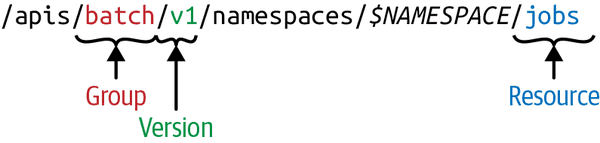 Fig: Programming Kubernetes Book
A GroupVersionKind (GVK) uniquely defines a kind.
A cluster can have two kinds with the same name.
Example: The cluster bewlo has two Node kinds but they are under different group version.
kubectl api-resources | rg NodeNAME SHORTNAMES APIVERSION NAMESPACED KIND
nodes no v1 false Node
nodes lhn longhorn.io/v1beta2 true NodeRest Mapping
When a client needs to access an object identified by a GVK, it must determine which GVR serves that object type. This process of mapping a GVK to a GVR is called REST mapping.
For example: apps/v1, Kind=Deployment maps to apps/v1, Resource=deployments
The GVR is then used to construct REST paths such as: /apis/apps/v1/namespaces/default/deployments/nginx
Resource Versioning
Not to be confused with an object's
.metadata.resourceVersion
Kubernetes api groups have a standard versioning policy.
Commonly, groups have alpha, beta and Generally Available (GA) versions.
Example: Group apps has v1,v1beta1 and v1beta2.
Contrary to what one minght think, even a stable version of a resource can have experimental fields that may be
removed in future releases.
Example: batch/v1 Job has .spec.ttlSecondsAfterFinished which was marked as alpha.
As of now (v1.33) it's considered GA.
type JobSpec struct {
    ...
    // This field is alpha-level and is only honored by servers that
    // enable the TTLAfterFinished feature.
    TTLSecondsAfterFinished *int32 `json:"ttlSecondsAfterFinished,omitempty"
}
Pods and many other types that were added to Kubernetes very early on are part of the core group—often also called the legacy group—which is represented by the empty string. Hence, apiVersion is just set to "v1.”